
Kiri is one of the most common processed cheeses found in French households, and the question of its introduction into a baby’s diet often arises during weaning. Rather than sticking to a fixed age, it is more useful to cross-reference the nutritional data of the product with the official weaning guidelines and the child’s actual maturity.
Kiri’s Composition Compared to Other Baby Cheeses
The choice of cheese during weaning is based on three measurable parameters: calcium, salt, and fat content. Here’s how Kiri compares to other common cheeses offered to young children.
| Criterion | Kiri (portion) | Pressed cheese (e.g., Emmental) | Plain fresh cheese |
|---|---|---|---|
| Calcium | Source of calcium (about 15% of nutritional guidelines per portion according to Ribambel/Kiri) | High calcium content | Moderate content |
| Salt | Present (a pinch of salt according to the ingredient list) | Variable, sometimes high (Parmesan, feta) | Generally low |
| Fat | Whole milk cheese, appropriate fat content | Whole milk, significant fat content | Variable depending on type (whole or reduced fat) |
| Additives | No added additives, no melting salts | None in raw versions | None in plain versions |
Kiri stands out for its lack of additives and melting salts, a point the brand emphasizes and which is confirmed by the composition published on the Ribambel website. Its base of pasteurized fresh milk places it in a different category from conventional industrial processed cheeses.
To better understand when to introduce Kiri according to Parlons Enfance, it is also important to consider the baby’s digestive maturity and not just their birth date.

Age for Introducing Kiri: What Medical Sources Say
Two guidelines coexist in the research findings. The website Cooking for my baby mentions a possible introduction from 6 months, while Ribambel (the official Kiri site) and pediatrician Alain Bocquet, cited by mpedia.fr, indicate a possible introduction from 9 months.
This difference is explained by the approach taken. At 6 months, weaning begins with purees and smooth textures. Processed cheese, even creamy, represents a more complex texture.
The Child’s Maturity Takes Precedence Over Civil Age
The French weaning recommendations, as part of the National Nutrition Health Program (PNNS), whose new edition covers the period 2025-2030, emphasize one point: the child must hold their head up and swallow purees properly before any introduction of solid or semi-solid foods. An 8-month-old baby who still struggles with textures is not ready for Kiri, even if the “official” age would allow it.
In practice, the signs to observe are clear:
- The baby holds their head up without assistance and sits with minimal support, which limits the risk of choking.
- They show interest in the foods on their parents’ plates and open their mouths spontaneously.
- They swallow purees without systematically pushing them out with their tongue (disappearance of the extrusion reflex).
Salt and Processed Cheese for Babies: An Underestimated Parameter
Competing articles largely highlight Kiri’s calcium content. However, the issue of salt deserves more precise attention, as it is recommended to limit the salt content of foods offered to young children.
Kiri contains a pinch of salt according to its own ingredient list. It is not a very salty cheese compared to Parmesan or feta, but giving processed cheese at every meal accumulates sodium intake throughout the day. An occasional portion is not a problem. A systematic daily portion, combined with other salty foods, can exceed the thresholds suitable for an infant.
Appropriate Frequency and Quantity
Kiri is packaged in individual portions, making it easy to measure. One portion corresponds to what pediatricians consider a reasonable amount for a meal. The consistent recommendation based on available data is: offer Kiri a few times a week, not at every meal.
Alternating with other sources of calcium (plain fresh cheese, whole milk yogurt, breast milk, or infant formula) allows for varied intake without overloading on salt.
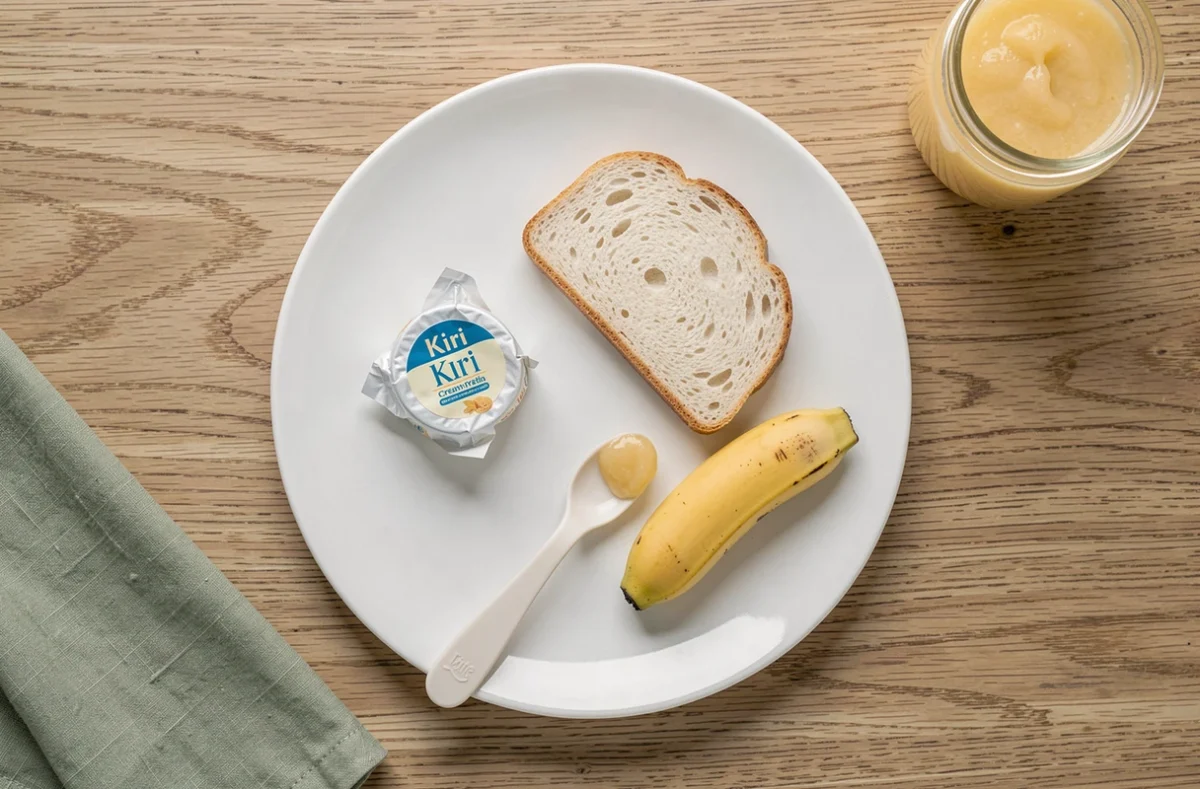
Kiri and Infant Formula: A Nutritional Hierarchy to Respect
A common pitfall is to consider cheese as a substitute for liquid dairy products. For a child under one year old, breast milk or infant formula remains the basis of their diet. Kiri, like any cheese, is only a supplement within the context of weaning.
This distinction has practical consequences. A 9-month-old baby who still drinks four bottles a day does not need cheese at every meal to meet their calcium needs. Cheese enriches the discovery of textures and flavors, not replaces a bottle.
The pediatricians consulted by mpedia.fr (source cited by Ribambel) confirm this approach: cheese for children is integrated into a varied meal, in small quantities, alongside vegetables, starches, and a source of protein.
Culinary Use Rather Than Raw Portion
Kiri melts easily, allowing it to be incorporated into preparations:
- Mixed into a vegetable puree to add creaminess and familiarize the baby with new flavors.
- Incorporated into a vegetable gratin suitable for the child’s age, with gentle cooking.
- Offered in small pieces for babies who are starting to eat with their fingers, usually after 9 months.
This culinary use dilutes the salt content per portion while maintaining the intake of calcium and fat.
The age displayed on parenting guides serves as a reference, but the determining factor remains the individual maturity of the baby regarding semi-solid textures. A Kiri introduced at the right time, in moderate quantity, and alternating with other dairy products, integrates smoothly into the weaning process.