
Organizing a wedding means coordinating an average of ten service providers, managing a guest list with variable geometry, and balancing a tight budget. The stress does not come from the wedding itself, but from the multitude of micro-decisions to be made over several months. Setting a clear framework from the start radically changes the experience.
Wedding Budget: Set the Financial Framework Before Choosing Anything
The primary source of tension for engaged couples remains money. Not the total amount, but the ambiguity surrounding its allocation. A couple visiting reception venues without having defined their overall budget is exposed to a cascade of disappointments.
The reflex to adopt: break down the budget into four or five main categories before even contacting a single service provider. The venue and the meal usually take up the largest share. Next come the wedding dress, floral decoration, photography, and music.
To find inspiration and compare available services in France, a useful resource is https://www.mon-beau-mariage.fr/, which groups providers by region and specialty.
A simple spreadsheet, even on a basic program, is enough to track received quotes, deposits paid, and the remaining balance. This document becomes the project’s dashboard. Without it, expenses accumulate without visibility, and financial stress gradually increases.
Guest List and Seating Plan: The Two Tasks That Generate the Most Conflicts

The guest list is rarely a neutral exercise. It crystallizes family tensions, social obligations, and venue capacity constraints. It’s better to treat it as a logistical problem rather than a relational question.
Lock in the Number Before the Names
First, define a maximum capacity, dictated by the venue and meal budget. The number of guests dictates almost all other choices: caterer, room size, number of tables, quantity of invitations. Without this figure, everything remains uncertain.
An effective method is to create three distinct lists:
- People whose absence would be unthinkable (close family, witnesses, close friends)
- People the couple sincerely wishes to have present, without obligation
- People invited out of courtesy, who will only be contacted if capacity allows
This sorting avoids last-minute compulsive additions and painful withdrawals.
The Seating Plan: A Matter of Constraints More Than Preferences
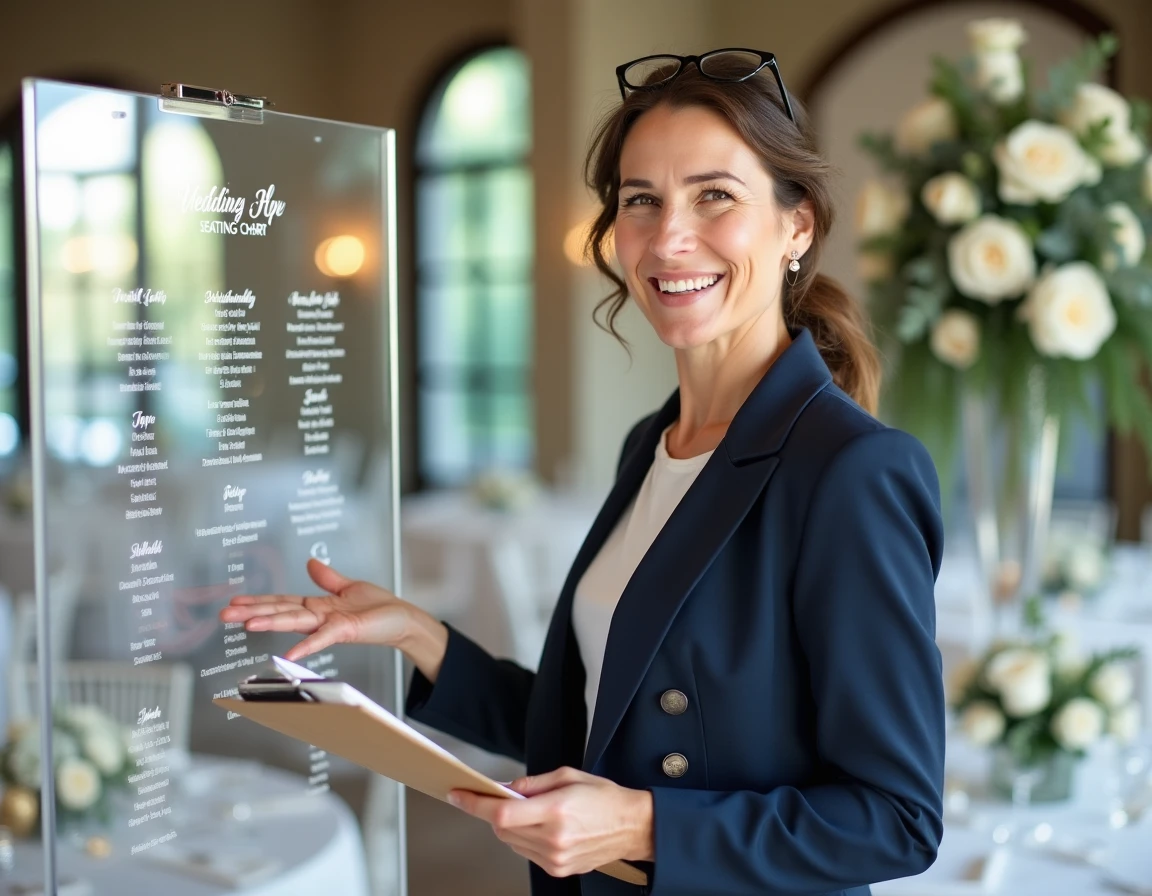
Placing guests works better by reasoning through incompatibilities. First, identify people who should not sit next to each other, then group by affinities. The perfect seating plan does not exist. A functional plan where no one has a bad evening is more than sufficient.
Coordination on the Big Day: Delegate the Management of Unforeseen Events
Even with impeccable planning, the wedding day always generates last-minute adjustments. A late service provider, a change in weather, a sound issue. The difference between a stressful wedding and a serene one often hinges on one point: who manages these unforeseen events?
In recent years, the demand for day-of coordination services only has significantly increased in France. The principle: a professional intervenes on the day of the ceremony to oversee the schedule, follow up with service providers, and resolve issues without involving the couple. This service costs significantly less than full support over several months.
For couples who prefer not to hire a coordinator, designating a trusted person (a witness, an organized friend) with a precise timing document and the contact numbers of all service providers produces a comparable effect. The goal remains the same: the couple should not be their own manager on the big day.
Wedding Dress and Attire: Anticipate Manufacturing Delays
Delays on the wedding dress are among the most frequent and avoidable sources of stress. A custom dress or one ordered from a designer often requires several months between the initial order and final delivery, including alterations.
The typical timeline breaks down as follows:
- First fitting and order: at least eight to ten months before the wedding date
- Receiving the dress and first alterations: three to four months before
- Final alterations and last fitting: four to six weeks before the ceremony
Ordering late does not necessarily mean disaster, but it reduces options. Ready-to-wear wedding collections offer alternatives with shorter timelines. Anticipating alterations is as important as choosing the model.
Ceremony and Meal: Focus Energy on What Guests Really Remember
Guests remember three things: the quality of the meal, the atmosphere of the evening, and the emotion of the ceremony. Table linens, place cards, and stationery matter much less in their memories than the time couples spend on them.
Reducing the number of minor decorative details frees up time and budget for high-impact items. A good caterer, a DJ or musician tested in advance, and personalized vows leave a greater impression than a candy bar or a photobooth.
The secular ceremony, in particular, benefits from being prepared with a real narrative thread rather than as a succession of readings and songs. A short and sincere text, read by a close friend who knows the couple well, has more impact than an elaborate staging.
The least stressful wedding is not the one where everything is perfect; it is the one where priorities are clear from the start. Three or four structuring decisions (budget, number of guests, venue, delegation for the big day) absorb most of the complexity. The rest can be adjusted.