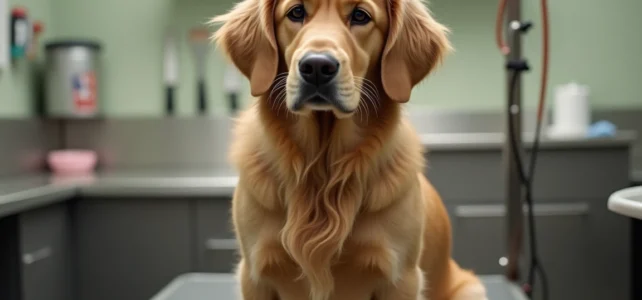
Your dog returns from grooming and, instead of proudly showing off its new haircut, lies down in a corner, refuses to play, or looks at you with dull eyes. This behavior surprises many owners. The good news: in the vast majority of cases, a dog that seems sad after grooming is not suffering from depression. Its discomfort is temporary, and once the causes are understood, they can be corrected quite easily.
Sensory overload in the grooming salon: the invisible stress of grooming
Before looking for complex psychological causes, it’s important to consider what happens during the grooming session. A grooming salon concentrates several simultaneous sensory assaults.
First, the noise. Clippers, industrial hair dryers, barking from other dogs: the noise level in a salon far exceeds what a dog experiences on a daily basis. Canine hearing picks up frequencies much broader than ours, making each device even more overwhelming for them.
Next, the smells. Shampoos, detangling products, scented sprays: these fragrances mask the dog’s natural scent. However, smell structures how a dog navigates its environment and interacts with other animals. Losing its familiar scent, even temporarily, can cause a state of disorientation.
Finally, the restraint. Staying still on an elevated table for an extended period, handled by an unfamiliar person, represents a considerable physical and mental constraint. Panting, repeated yawning, and forced immobility are well-identified stress markers in dogs.
The result: an animal that comes out of the session “dazed,” drained of energy, which its owner interprets as sadness. It is possible to understand why a dog appears depressed after grooming on Animal News, where post-session fatigue is detailed from this sensory perspective.
Dog disturbed by its new appearance: the role of smell and the gaze of others
Have you ever noticed that other dogs sniff your companion more intensely after grooming? This is not trivial. A clipped or washed dog with scented shampoo carries a modified olfactory signature. For its peers, it “smells different,” which triggers persistent sniffing, and sometimes avoidance or excessive curiosity.
This change in social interactions can destabilize a sociable dog. Groomers and trainers report that some dogs become inhibited or anxious after a very short clip, precisely because they receive unusual reactions from other dogs in the household or neighborhood.
The phenomenon goes beyond just the scent. A dog whose coat is significantly shortened also loses some of its tactile references. The contact of air on the skin, the unusual sensation of cold or heat, all of this creates slight discomfort that contributes to withdrawal. This is not sadness in the human sense, but rather a state of passive alertness: the dog is waiting for things to return to normal.
Signs of post-grooming stress or a real health problem: distinguishing between the two
Most of the time, the downcast behavior lasts a few hours, sometimes one or two days. Beyond that, the situation deserves different attention. Here are the elements to watch for:
- The dog refuses to eat for more than 24 hours or vomits after grooming. This may indicate a reaction to a product ingested by licking (shampoo, spray) or a gastric issue unrelated to the session.
- Persistent trembling, abnormal gait, or a body area that the dog avoids being touched. A skin irritation, a micro-cut, or a slight burn from the clippers may sometimes go unnoticed at the salon.
- A change in behavior that persists beyond three days: ongoing isolation, total lack of play, excessive sleeping. A lasting lethargy warrants a veterinary consultation to rule out a medical cause (pain, skin infection, allergic reaction).
Discussions among owners on specialized forums mention cases of trembling and lethargic dogs after grooming, where the medication angle (light sedation practiced by some salons without the owner’s consent) has been raised. If your dog’s behavior seems disproportionate, asking the groomer about the products and methods used is a useful reflex.
Reducing grooming stress: concrete solutions that change the session
Adapting the session is better than consoling the dog afterward. A few adjustments make a real difference.
Gradually acclimate the dog to handling
A puppy or a recently adopted dog has no reason to tolerate a full session right away. Breaking the first visits into short steps (grooming only one area per session) significantly reduces sensory overload. Testimonials from breeders confirm that a first grooming session that is too long or too radical can leave a lasting mark on the dog’s behavior in subsequent sessions.
Choose a groomer suited to the dog’s temperament
Not all salons operate the same way. Some groomers allow the owner to stay present, others use a forced air dryer (less noisy than a traditional hair dryer), and some work in individual boxes to limit external stimulation.
- Ask if the salon isolates anxious dogs from barking dogs.
- Check the drying method: warm forced air generates less stress than a high-temperature hair dryer.
- Prefer a groomer who agrees to break the session into parts for a sensitive dog.
- Ensure that no calming product is administered without your explicit consent.
Welcoming the dog calmly after the session
Upon return, avoid overcompensating with excessive cuddles or a high-pitched voice. This type of reaction confirms to the dog that there is indeed a reason to be stressed. Resuming the usual routine (calm walk, food at the normal time) sends the signal that nothing serious has happened.
A dog that seems sad after grooming most often expresses a temporary sensory fatigue, not a deep malaise. The noise, smells, restraint, and change in appearance combine to produce this “dazed” state that generally disappears within a few hours. By adapting the frequency, duration, and conditions of the session, most dogs eventually experience grooming as a neutral, or even pleasant, moment.