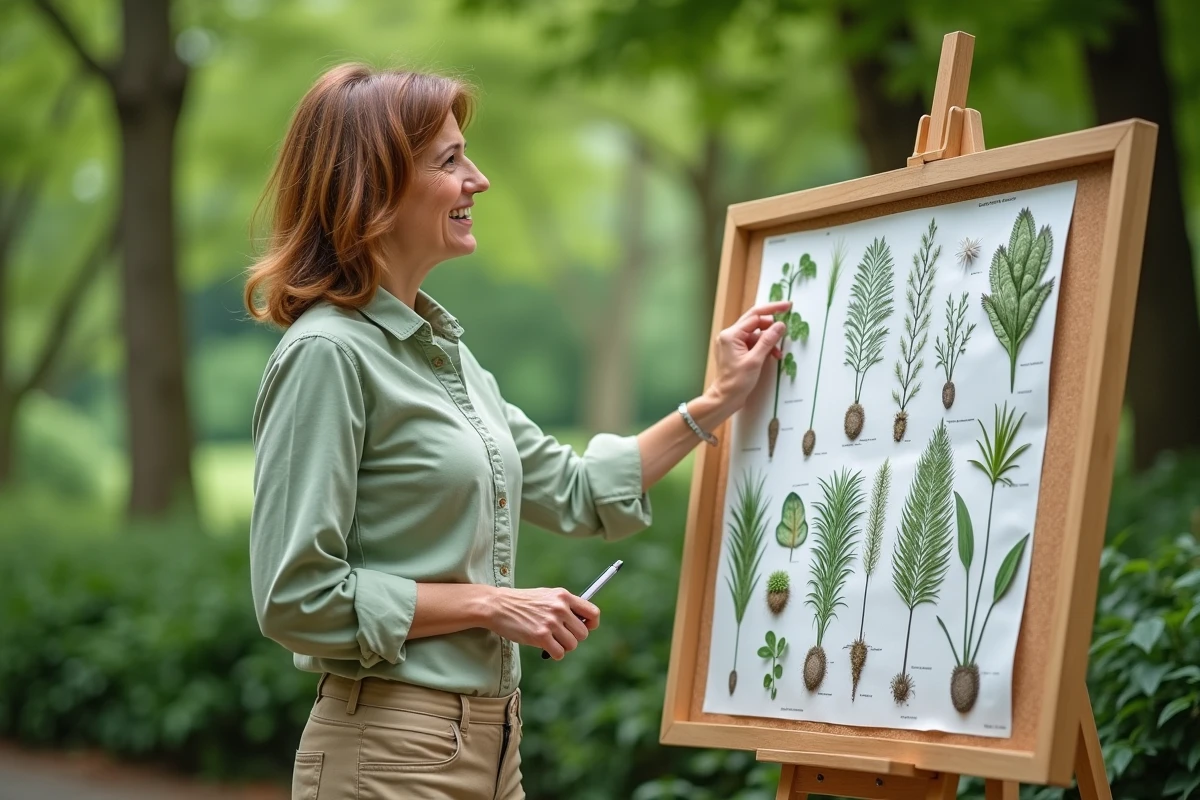
Fungi have not been classified among plants for several decades, despite centuries of confusion in textbooks. Some unicellular algae share more similarities with animals than with trees or ferns. Mosses, which are found in almost every terrestrial environment, lack true roots and a complete vascular system.
The criteria for classifying plants continue to evolve: they now rely on genetics, cellular structure, and life mechanisms, whereas in the past, only form mattered. This ongoing refinement provides a much more nuanced view of the relationships between species and redefines the landscape of the plant kingdom.
Why classify plants? Understanding the stakes of botanical taxonomy
Giving a place to each plant species allows us to see beyond mere apparent diversity. Through taxonomy, we build a reliable map of living organisms, which is essential for life sciences, research, ecology, and agronomy. Carl von Linné, in the 18th century, invented the binomial system: each plant has two Latin names, genus and species, bringing order to the plant world. With the classification of plants in biology, research has significantly refined the criteria: modern systematics combines morphological descriptions, anatomical observations, and molecular analyses to better illuminate the actual relationships between species.
Now, phylogeny disrupts old habits: clades, groups inherited from a common ancestor, are favored over collections with uncertain boundaries. The most well-known example remains the work of the APG, which, by rewriting the classification of flowering plants in light of DNA, repositions each lineage in the grand evolutionary narrative. Since Darwin, we no longer view the tree of life in the same way: it is animated by intertwined stories, unexpected bifurcations, and tiny silent revolutions.
Classifying is primarily about preparing tools to predict, protect, and understand plant reactions in a changing world. Navigating the jungle of species is anything but abstract: it is a means to uncover mechanisms of adaptation or resistance that are already shaping the forests and meadows of tomorrow.
From algae to flowering plants: the major groups of plants under the microscope
Dividing the plant kingdom into major groups reconstructs the long journey from water to land. This journey begins with chlorophytes, these green algae considered the mother branch from which continental plants will later emerge. Their ability to harness light and photosynthesis plays a decisive role in evolution.
The real leap occurs with land plants or embryophytes. As soon as a plant develops a cuticle to limit water loss and enhanced protection for the embryo, the march toward terrestrial environments begins. Among these pioneers are bryophytes, mosses, liverworts, and hornworts, which remain dependent on moisture, lack a complete vascular network, and reproduce via spores dispersed by water or wind.
The next step brings us to pteridophytes: ferns, horsetails, and clubmosses. These plants mark the appearance of conducting vessels, thus crossing a key threshold for the rise of forests. They also propagate by spores but exhibit a much superior internal organization compared to bryophytes.
The final stage of complexity arrives with spermatophytes, the seed plants. Two main branches are distinguished:
- Gymnosperms: conifers, ginkgo, cycads. Their seeds are not enclosed in a fruit; they remain exposed.
- Angiosperms, or flowering plants. Their current dominance comes from their winning duo of “flowers and fruits,” which both protect and efficiently disseminate seeds.
Here’s how they are identified:

Lower and higher plants: what are the differences and how to easily recognize them?
To distinguish between lower plants and higher plants, we observe their structure, lifestyle, and evolutionary history. The so-called lower plants mainly include bryophytes and pteridophytes. Their common feature is the absence of true conducting tissue. Water and nutrients diffuse slowly, limiting their size and tying them to humid environments. Their reproduction relies on spores: poorly protected, often dispersed by the elements.
In higher plants, or spermatophytes, it is the seed that changes everything. The development of vessels allows for the rapid transport of sap, while reproduction by seeds ensures effective dissemination and real protection for the embryo. This large group is again divided as follows:
- Gymnosperms: naked seeds, often exposed on cones.
- Angiosperms: seeds enclosed in a fruit, with clear marks of flowers and fruits to distinguish the family.
Each subgroup has its distinct visible characteristics:
To identify the group to which a plant belongs, one looks for several clues: a complete leaf? A woody stem? A well-defined root system? From ephemeral annual plants to centennial trees, the diversity of forms, trees, shrubs, subshrubs, herbaceous plants, illustrates the creativity of these adaptations. Life cycles, whether annual, biennial, or perennial, reflect other strategies for occupying space.
Every fern nestled in a crevice, every oak towering above the underbrush embodies this long history in its own way. Understanding the place of each group is to grasp the secret thread that today connects the fragile moss to the most majestic of forests.