The calculation of a volume in cubic meters relies on simple geometric formulas, but the reliability of the result depends less on the formula than on the quality of the measurements provided. The relationship 1 m³ = 1,000 liters is exact, established by the BIPM through the equivalence 1 L = 1 dm³. Any error in the final result thus comes from the initial dimensions, not from the conversion itself.
Measurement Uncertainty and Propagation in Volume Calculation
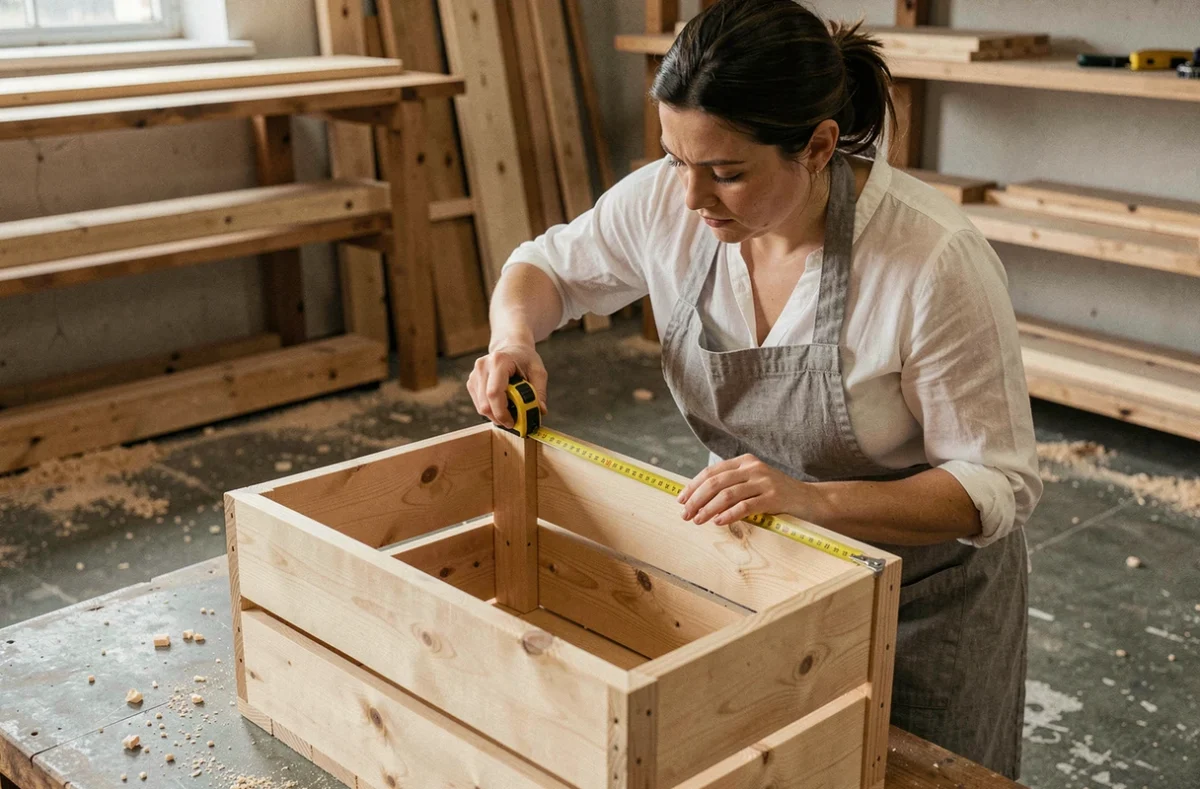
Multiplying three dimensions to obtain a volume amplifies the inaccuracies of each individual measurement. In a rectangular parallelepiped, an error of a few millimeters in length, width, and height compounds in the final product. The displayed result should never have more decimal places than the least precise measurement.
In practice, a construction tape measure and a laser rangefinder do not provide the same resolution. Displaying a volume to four decimal places based on measurements taken to the nearest centimeter is a false precision. We recommend rounding the result to a number of significant figures consistent with the instrument used.
This concept, derived from metrology, is often absent from most online calculation guides. However, it changes the game for sizing tanks, estimating concrete quantities, or assessing the capacity of a reservoir. The conversion to liters never corrects an imprecise measurement: it simply carries it over as is into another unit.
To delve deeper into the relationship between these two units and verify your conversions, you can find how many liters are in 1 cubic meter on Immogenius with detailed examples.
Usable Volume and Geometric Volume: A Distinction Not to Be Overlooked

Applying the formula length × width × height to the outer dimensions of a container does not give its actual capacity. The thickness of the walls, internal reinforcements, fittings, or equipment (sensors, stirrers, coils) reduce the available volume. The usable volume is always less than the gross geometric volume.
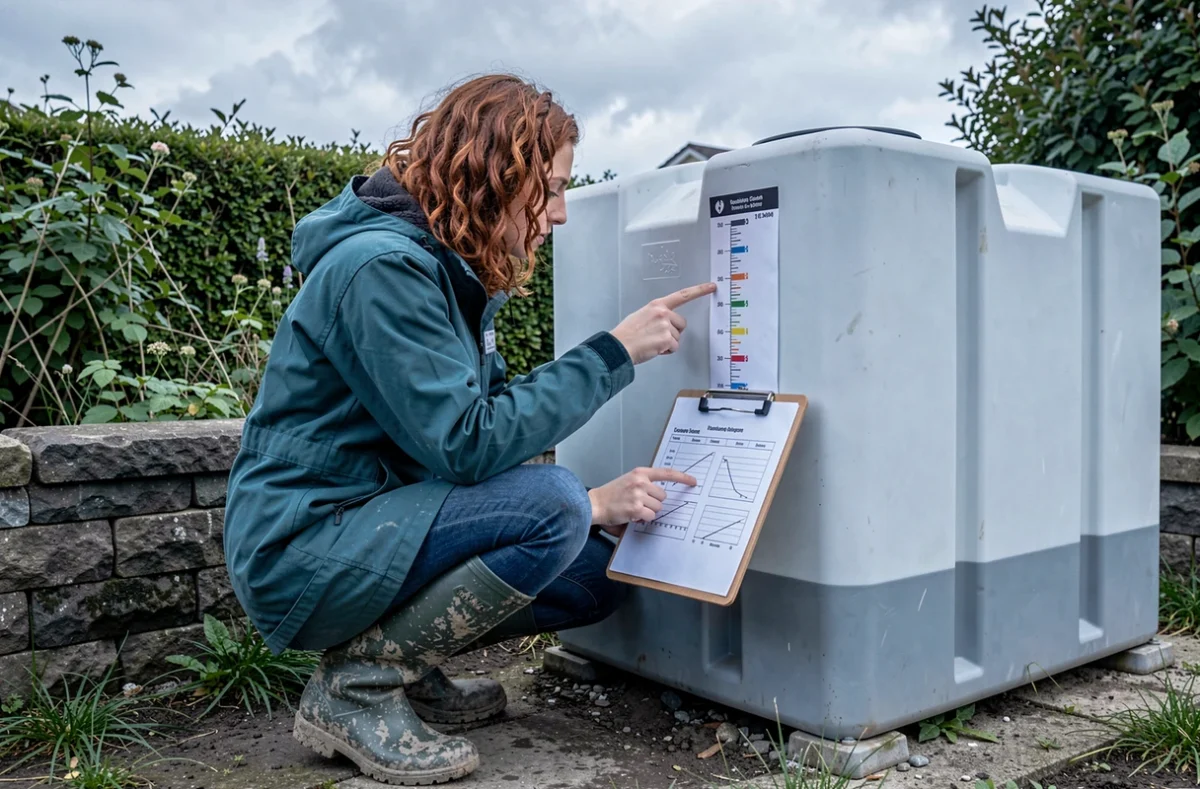
For an industrial tank or a retention basin, the nominal capacity indicated by the manufacturer corresponds to the internal volume measured under standardized conditions. If this data is not available, the internal dimensions must be measured, not the external ones.
This distinction has direct consequences on the ground:
- A water tank whose external volume calculates to a certain number of cubic meters will contain significantly fewer liters once the walls and plumbing are deducted.
- A concrete formwork sized to the external dimensions of the mold will overestimate the amount of material needed if the walls are thick.
- An aquarium or technical tank sees its actual capacity decrease as soon as substrate, filters, or partitions are installed.
The correct reflex is always to ask the question: do the dimensions I am measuring correspond to the space I am trying to fill?
Volume Formulas for Common Shapes in Cubic Meters
The choice of formula depends on the geometry of the solid. Three cases cover the majority of practical situations.
Rectangular Parallelepiped (Cuboid)
Volume = length × width × height. All dimensions must be expressed in meters to obtain cubic meters directly. If the dimensions are in centimeters, divide each value by one hundred before multiplying, or divide the result in cm³ by one million.
Cylinder
Volume = π × radius² × height. The radius is half of the inner diameter. A common mistake is to use the diameter without dividing by two, which quadruples the result. For vertical cylindrical tanks, the height corresponds to the filling height, not the total height of the container if it is not filled to the brim.
Sphere
Volume = (4/3) × π × radius³. This calculation pertains to spherical storage balloons or pressure tanks. Measuring the internal radius remains the main difficulty, often resolved by the manufacturer’s data.
Convert Cubic Meters to Liters Without Scale Errors
The conversion itself is arithmetically trivial: multiply the volume in m³ by 1,000 to get liters. The trap lies in the submultiples.
A correspondence table clarifies the orders of magnitude:
| Unit | Equivalence in liters |
| 1 m³ | 1,000 L |
| 1 dm³ | 1 L |
| 1 cm³ | 0.001 L (1 mL) |
The most common confusion occurs between dm³ and m³. A factor of one thousand separates these two units, and a prefix error can turn a material order or dosage into an aberrant result.
For volumes expressed in cubic centimeters, the conversion to liters involves dividing by one thousand. A volume of several tens of thousands of cm³ represents a few tens of liters, not a few hundreds.
Practical Cases Where the m³-Liters Conversion Changes the Expected Result
The calculation of volume and its conversion to liters occurs in contexts where errors are costly. The estimation of a concrete slab uses cubic meters as the ordering unit, while the dosage of additives is expressed in liters per cubic meter. Confusing the scales leads to overdosing or underdosing the mixture.
In water management, meters cubed are often displayed on meters. Converting consumption to liters allows for comparison with flow rates (expressed in liters per minute or per hour) and detecting leaks. A discrepancy of a few hundredths of a cubic meter per day represents several tens of liters.
The volume in cubic meters remains the reference unit for transport and storage. The conversion to liters only makes sense when handling liquids or comparing capacities expressed in different units. Applying the correct geometric formula, measuring the internal dimensions, and respecting the precision of the measuring instrument are sufficient to obtain a usable result.