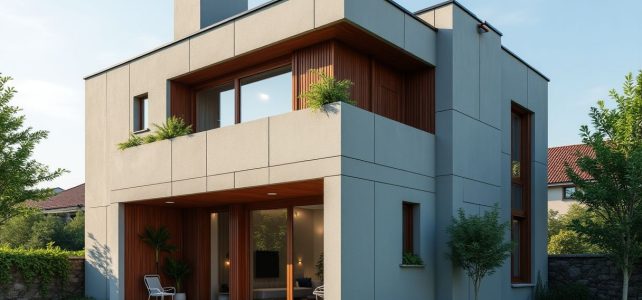
In the face of current environmental and economic challenges, the energy efficiency of buildings has become an essential priority. Among the existing solutions, external insulation emerges as an innovative technique that combines performance and aesthetics. This method not only improves the thermal comfort of homes but also significantly reduces energy consumption. With increasingly harsh winters and scorching summers, ensuring a well-insulated home has become a necessity.
How does this technique work? What are its advantages and disadvantages?
The principle of external insulation
External insulation is based on a simple and effective concept. It involves wrapping the building in an insulating layer to prevent heat loss.
- The composition: The insulation system generally consists of insulating panels fixed to the facade. These panels are covered with a protective coating.
- The materials: Sometimes, materials such as rock wool, polystyrene, or polyurethane are used due to their excellent thermal properties.
- The techniques: The methods vary, ranging from ventilated cladding to rendering on insulation, each having its own characteristics.
- The advantages: This approach has the dual benefit of improving energy efficiency while rejuvenating the exterior appearance of the building.
Environmental and economic benefits
External insulation stands out particularly in terms of environmental and economic benefits. It helps reduce the carbon footprint of constructions.
Energy performance: By limiting thermal losses, this technique allows for a significant reduction in heating bills. A well-insulated house consumes less energy, resulting in substantial savings for the occupants.
Environmental impact: Less energy consumed also means fewer fossil resources exploited. This translates into a notable reduction in greenhouse gas emissions, contributing to environmental preservation.
Property value enhancement: A better-insulated property sees its value increase. External insulation improves the aesthetic appearance of the building, which can translate into an increase in the real estate market.
The different types of insulation systems
There are several systems for external insulation, each presenting specific characteristics suited to various needs.
- Render system: Suitable for modern buildings, this involves fixing an insulating material to the outer wall before covering it with a render. This system is appreciated for its discretion and uniform aesthetics.
- Ventilated cladding: Preferred for wooden or metal constructions, cladding creates a ventilation space between the insulation and the exterior coating, preventing moisture from damaging the structure.
- Panel insulation: Prefabricated panels are fixed to the facade. They offer quick installation and are often used for renovation projects.
Limitations and precautions to take
Although this technique offers many advantages, there are certain limitations and precautions to consider for successful implementation.
First of all, a preliminary analysis of the facade is essential to determine the feasibility of the project. Some structures may require reinforcements.
It is also necessary to comply with local regulations in terms of urban planning. External modifications must conform to current standards, and permits may be required.
Finally, choosing qualified professionals is essential to ensure the quality of the installation. Poor implementation can lead to water infiltration problems and compromise the effectiveness of the insulation.